
FRA Railroad DER TrainingDesignated Employer Representative
Choose the correct railroad testing route, coordinate providers, handle post-accident duties, and document employer decisions under Part 219.
Run the employer side of your FRA Railroad testing program
Build a practical contact route, respond to testing problems, act on results and protect the records behind employer decisions. Shared DOT procedures lead into agency-specific cases.
Practice post-accident calls with FMCSA’s rules
Play Post-Accident Clock (FMCSA rules)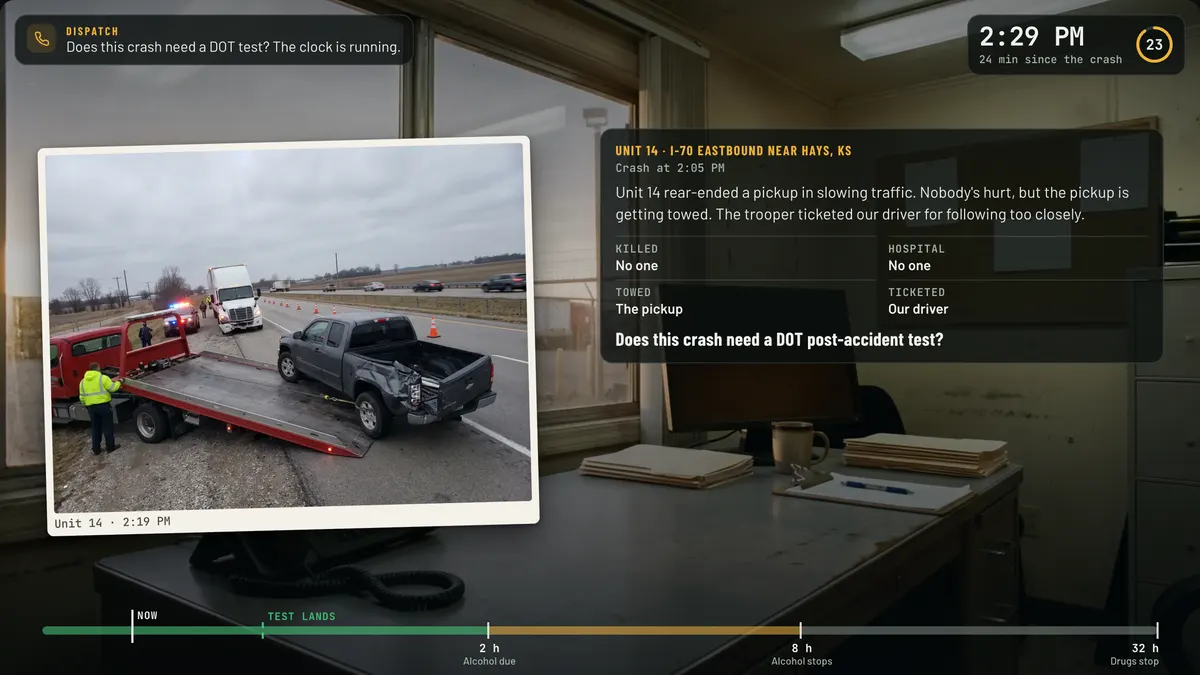
Your course, module by module
17 modules, ending with a 25-question final (80% to pass).
- 01
Choose the Railroad Testing Route
- 02
DER Authority and Routing
- 03
Set Up the Testing Network
- 04
Run a Part 40 Drug Test
- 05
Handle Collection Problems
- 06
Act on Drug Results
- 07
Coordinate Recovery and Return
- 08
Protect Records and Oversee Vendors
- 09
Operate the Program Day to Day
- 10
Coordinate Part 40 Alcohol Testing
- 11
Coverage and Railroad Responsibility
- 12
Program Setup and Training Oversight
- 13
Routine Testing Decisions
- 14
Post-Accident Toxicology
- 15
Violations Assistance and Return
- 16
Records Reporting and Railroad Case
- 17
Final Assessment
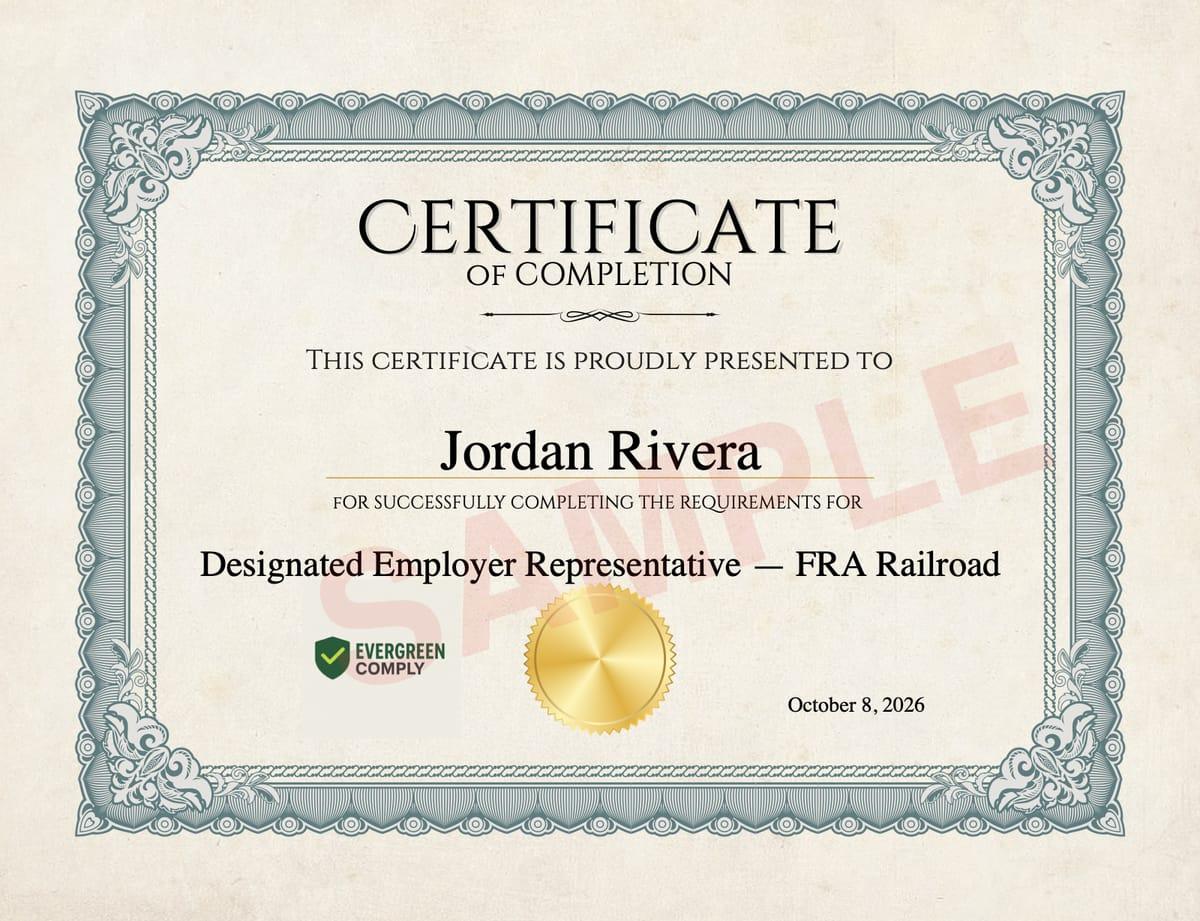
Certificate and regulatory crosswalk
Learners download their certificate when they pass the final. Keep it with the bilingual crosswalk as a record of what the course covered.
Who should take it
Railroad drug and alcohol program administration. Separate supervisor training, safety-related qualifications and employer-specific program requirements still apply.
Rules behind the course
Every module maps to the exact regulation this course trains for. Each citation links to the official regulatory text.
- 49 CFR Part 40DOT testing procedures and employer responsibilities where applicable.
- 49 CFR Part 219Railroad alcohol and drug rules, testing programs, post-accident toxicology and responsive action.
- 49 CFR 219.11(g)Separate railroad supervisor-training responsibilities.
- 49 CFR Part 243Separate training and qualification framework for covered safety-related railroad duties.
Completion training, not government approval, licensure or a guarantee of employer compliance. It doesn’t replace supervisor, collector, BAT, MRO or SAP qualification.
Practical references included
No textbook needed. The learner aids and bilingual crosswalk are free to download.
DER and reasonable suspicion guides
Plain-English answers to the questions DERs and supervisors ask most, each checked against 49 CFR Parts 40 and 382.
FRA Railroad DER training questions
Who is this FRA Railroad DER course for?
Railroad and contractor staff who administer drug and alcohol testing programs under 49 CFR Part 219, including designated employer representatives, backups and program coordinators. Coverage depends on the work performed and the applicable railroad rules and exceptions.
Does this replace railroad reasonable suspicion supervisor training?
No. This course teaches testing-program administration. Supervisor training under 49 CFR 219.11(g), employee education, and any separate safety-related qualification or refresher training remain employer obligations. A DER who also serves as a supervisor must address both roles.
How often should FRA DER training be renewed?
Parts 40 and 219 do not establish a blanket annual renewal interval for this DER administration course. Review training when rules, duties, providers or employer procedures change, or an audit identifies a gap. This recommendation does not replace separate refresher requirements that may apply to safety-related duties under Part 243 or the employer’s training program.
Does federal law require purchase of this specific course?
No. The railroad and other covered employers remain responsible for their testing programs. Purchasing this Evergreen Comply course is not itself a federal requirement and does not replace employer-specific policies, required instruction or any applicable training-program approval.
Is this an FRA-approved certification?
No. The certificate records completion of this course. It does not appoint the learner as the employer’s DER, grant a railroad operating credential, approve a testing program, or establish qualification for every safety-related duty.
How long does the course take?
Allow about 4 hours including practice questions and the final assessment. There are approximately 2 hours 55 minutes of English video or 3 hours 25 minutes of Spanish video. Review time and individual pace vary.
Is the course available in Spanish?
Yes. English and Spanish lessons, quizzes and learner-reference booklets are included. Select your preferred language in the course.
Do learners need to buy a book?
No separate commercial textbook is required. Downloadable learner aids and a bilingual regulatory crosswalk are included. Keep your employer’s policy, provider contacts, required forms and current regulations available as well.
Does the course cover FRA post-accident toxicology?
Yes. It distinguishes ordinary Part 40 testing from the FRA Subpart C toxicology route, including incident triggers, specimens, forms, collection responsibilities and reporting. The DER must identify the correct authority before arranging a test.
Are small railroads and contractors automatically exempt?
No. The course explains how to evaluate coverage and limited exceptions without treating a small-railroad exception as a waiver of every Part 219 duty. Contractor and volunteer work can also require a coverage review.
What assessment and certificate are included?
Practice questions follow the teaching modules. The final assessment draws 25 questions from a 60-question bank and requires 80% to pass. After meeting course completion requirements, the learner receives a completion certificate with the regulatory crosswalk appended.
Is this the same as FMCSA or hazardous-material shipping training?
No. This course addresses railroad drug and alcohol program administration under Part 219. Motor-carrier DER duties and hazardous-material shipping duties have separate requirements.

Start FRA Railroad DER training
$99 per learner, one time.