Hearing ConservationTraining for employees
Understand workplace noise. Use hearing protection correctly. Know what hearing tests tell you—and when to raise a concern.
44 minutes of video + assessments · English · Certificate included
General-industry employee education supporting 29 CFR 1910.95. Your employer completes the instruction for your exposure, protectors and workplace program.
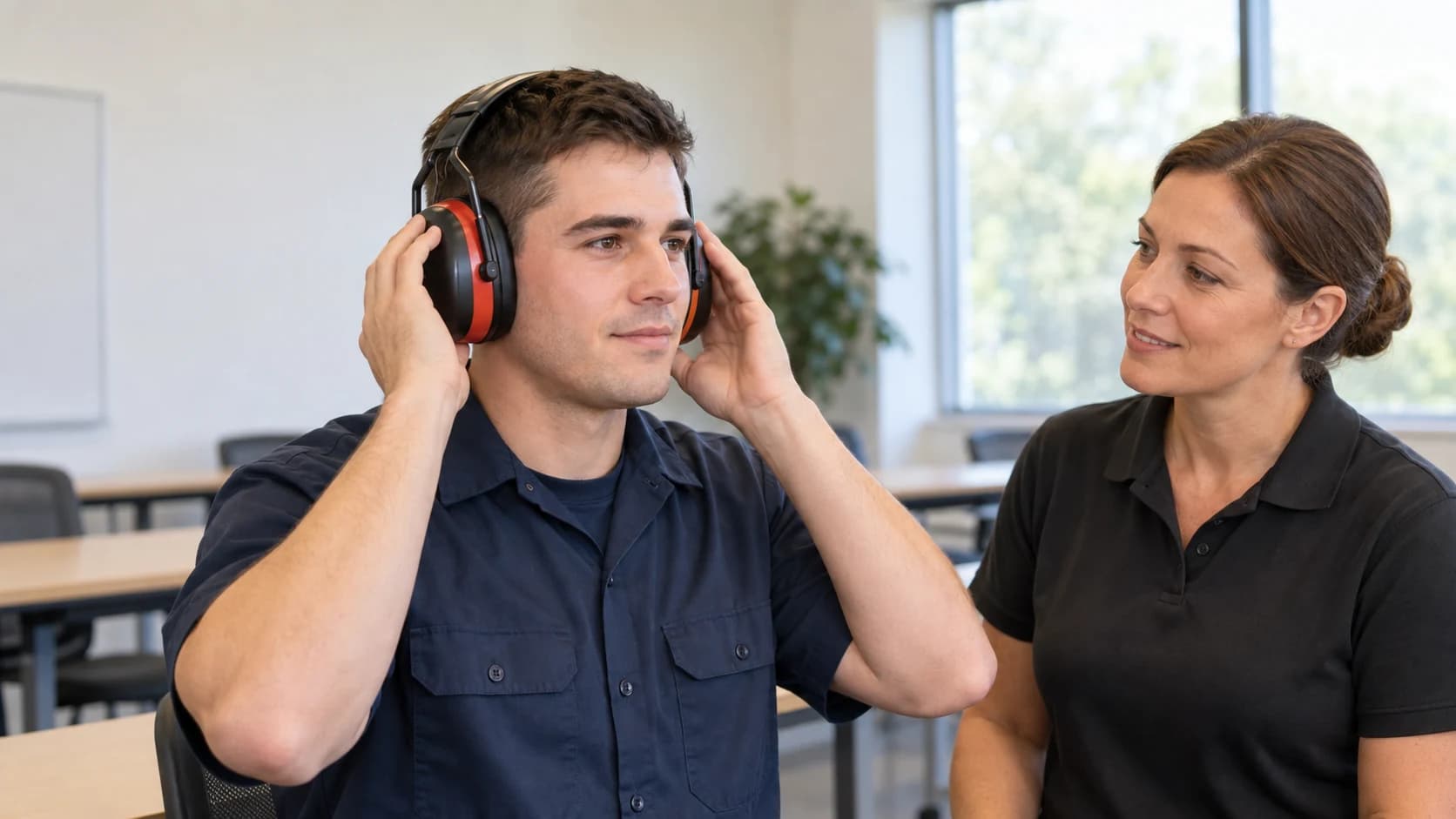
Protect the hearing you rely on
Noise damage can build before you notice a problem. The course connects everyday work situations to protector fit, exposure information and testing—so employees can take an informed part in their hearing conservation program.
- Recognize how noise intensity and exposure duration affect hearing
- Use and care for the hearing protectors supplied by your employer
- Understand the purpose of baseline and annual hearing tests
- Connect general instruction to your measured exposure and workplace procedures
Finish the instruction at your workplace
Review your measured exposure, when protection is required, the protectors actually supplied, their fitting and care, and your employer’s testing arrangements. Use the included fitting checklist and employer completion form to record that follow-up. The online course does not replace monitoring, controls, individual fitting or audiometric testing.
Seven modules, built around the employee’s role
Two questions follow each module. A ten-question randomized final assessment follows the teaching modules. Evergreen’s passing score is 80%, with unlimited retakes.
- 01
Understanding workplace noise
Noise sources, decibels, exposure duration and the 85 dBA action level.
- 02
How noise damages hearing
Temporary and permanent hearing changes, tinnitus and cumulative exposure.
- 03
The Hearing Conservation Program
Monitoring, employee notification and employer and employee responsibilities.
- 04
Hearing protection
Earplugs, earmuffs, selection, attenuation and the limits of different devices.
- 05
Proper use and care
Fitting, inspection, cleaning, replacement and when protection is required.
- 06
Audiometric testing
Baseline and annual audiograms, threshold shifts and why follow-up matters.
- 07
Employer-specific section
Your exposure results, supplied protectors, testing arrangements and contacts for concerns.
Who should take it
- General-industry employees enrolled in an employer hearing conservation program
- Manufacturing, maintenance and warehouse teams exposed to workplace noise
- Employees receiving initial or annual hearing conservation instruction
This is employee education, not audiometric technician or CAOHC certification. It does not replace a hearing evaluation or qualify someone to administer hearing tests. Construction and other separately regulated settings need instruction appropriate to their requirements.
Regulatory basis and annual training
- 29 CFR 1910.95(c)
Establishes the hearing conservation program action level of an eight-hour time-weighted average of 85 dBA.
- 29 CFR 1910.95(k)
Requires annual training covering effects of noise, hearing protectors and the purpose and procedures of audiometric testing.
- 29 CFR 1910.95(g), (i) and (j)
Addresses audiometric testing, hearing protectors and evaluation of protector attenuation.
Federal general-industry scope. State-plan requirements may add obligations. The certificate records online course completion; it is not OSHA approval or a guarantee of workplace compliance.
Connect online learning to your hearing conservation program
Keep employee education, workplace instruction and records together.
Purchase seats
Buy online or request a team invoice.
Assign learners
Distribute purchased seats through your account.
Complete workplace instruction
Review actual exposure and supplied protectors, and check fitting and care.
Keep records and plan the next training
Download the certificate and crosswalk. Use the annual planning reminder alongside your employer’s actual training schedule.
Review the course resources
The crosswalk maps this course to federal requirements. The forms support employer follow-up; they do not certify completion of unperformed instruction.
Hearing conservation training questions
Who needs hearing conservation training?
Where federal OSHA’s general-industry hearing conservation provisions apply, employers must provide training for employees exposed to noise at or above an eight-hour time-weighted average of 85 dBA. This course supports the training component of the employer’s hearing conservation program.
Is annual training required?
Yes. Under 29 CFR 1910.95(k), training must be repeated annually for each employee included in the hearing conservation program. Information must be updated to reflect changes in protective equipment and work processes. Your employer must also address applicable workplace and state-plan requirements.
Does the online course complete the employer’s program?
No. Employers must connect the instruction to actual noise exposure, the hearing protectors supplied, their use and care, and the workplace audiometric program. Monitoring, suitable protection, fitting instruction and testing remain employer responsibilities. Downloadable fitting and workplace-completion forms help record that follow-up.
How long does the course take?
There are approximately 44 minutes of video across 71 short lessons, plus seven module quizzes and a ten-question randomized final assessment. Allow additional time for assessments and employer-specific instruction. This is the course duration, not an OSHA-prescribed minimum.
What score do I need to pass?
Evergreen Comply requires 80% on assessments and allows unlimited retakes. The 80% score is our course standard, not an OSHA-mandated passing score.
What does the certificate show?
After completing the online course and passing its assessments, you can download an Evergreen Comply certificate of completion with a one-page regulatory crosswalk appended. It records this course’s completion; it does not certify that an employer’s entire hearing conservation program is compliant.
Is this an audiometric technician qualification?
No. This is employee education. It does not qualify someone to administer or interpret audiograms, replace a professional hearing evaluation, confer CAOHC certification, or provide an OSHA 10/30 Outreach card. Construction and other separately regulated settings need training appropriate to their applicable requirements.
What is the price and language?
The one-time base price is $29 USD per seat before applicable tax. The course is in English. Employers must ensure employees can understand their training and supply instruction appropriate to their language and literacy needs. Teams can purchase seats online or request an invoice.

Make hearing protection part of everyday work.
Practical employee instruction with workplace follow-up built in.