
DOT HAZMAT:Air Training (IATA DGR)
Required by DOT under 49 CFR 172.704 and the IATA Dangerous Goods Regulations: role-specific training to prepare, document, and offer dangerous goods for air transport.
100% onlineEnglish narrationInstant signed certificate
Course Overview
This course builds on regular DOT HAZMAT Advanced Awareness training and adds IATA Dangerous Goods Regulations (DGR) requirements for hazardous materials transported by air. It is designed for teams that must prepare, review, and offer compliant air shipments without delays at acceptance.
Training content aligns to DOT 49 CFR §172.704 and IATA DGR Section 1.5 recurrent training requirements (every 24 months). Learners should have access to the current IATA DGR manual throughout the course and when applying procedures on the job.
Air-mode specific
Focused on air limitations, acceptance, and air documentation workflows.
Role-based training
Designed for shippers, forwarders, handlers, and documentation teams.
Audit-ready records
Completion certificate and logs support compliance reviews and renewals.
49 CFR 107.329
Maximum civil penalties, adjusted annually for inflation
Why This Training Matters
PHMSA enforces hazmat violations under 49 U.S.C. 5123, with maximum civil penalties set by 49 CFR 107.329 and adjusted annually for inflation. Incorrect air shipment preparation can also lead carriers to refuse dangerous goods immediately.
Regulatory Basis
This course trains to both the DOT and IATA frameworks for dangerous goods by air. Each citation links to the official regulatory source.
- 49 CFR 172.704(a)The U.S. DOT hazmat employee training requirement that applies to all hazardous materials offered for transport, including by air.
- IATA DGR 67th Edition (2026)The current IATA Dangerous Goods Regulations, effective 1 January 2026, that carriers adopt for dangerous goods moved by aircraft.
- IATA DGR Subsection 1.5 (Training & Assessment)The dangerous-goods training/competency requirement, including recurrent training within 24 months of prior training.
- IATA competency-based training and assessment (CBTA)Maps dangerous-goods training and assessment to the functions personnel actually perform in the air-cargo chain.
Who Should Take This Course
This training is intended for employees whose job functions involve preparing, packaging, labeling, documenting, or offering hazardous materials for air transport.
Check the fit before you enroll
Not for: Teams that do not ship by air or only need standard DOT ground/hazmat training.
Prerequisite: Requires access to the current IATA Dangerous Goods Regulations manual and applies to actual air shipments.
Not shipping by air? Choose Advanced HAZMATWhat You’ll Learn
Understand the Regulatory Framework for Air Transport of Hazardous Materials.
Apply Air-Specific Compliance Requirements to Job Functions.
Identify and Manage Air Transport Restrictions and Documentation Obligations.
Course Preview
Certificate + Compliance Records
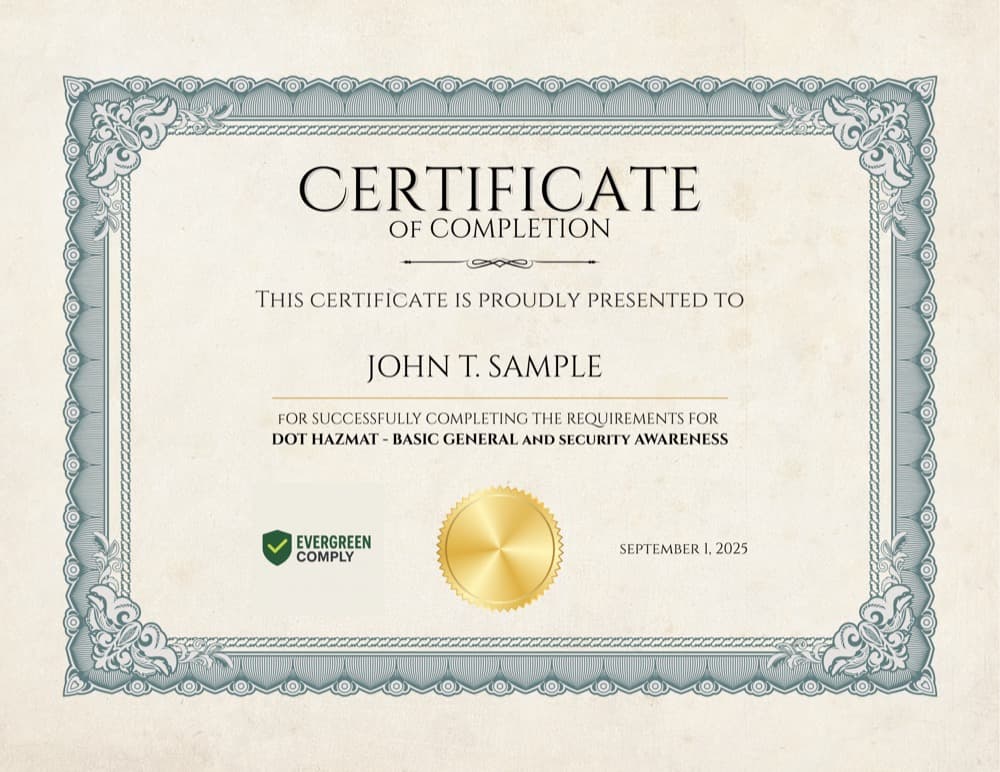
Learners receive an audit-ready completion certificate and training log upon passing the final assessment. Records are formatted to support DOT training documentation and IATA recurrent training tracking intervals.
Course Modules / Outline
11 focused modules for air transport compliance.
- 00Orientation
- 01Air Limitations and Variations
- 02Classification and Identification
- 03List of Dangerous Goods Decision Engine
- 04Packing Strategy
- 05Marking and Labelling
- 06Documentation and Audit Trail
- 07Handling and Handoffs
- 08Special Cases (Pack 01)
- 09Significant Changes 2026 (IATA DGR 67th Edition)
- 10Capstone and Assessment
Get Your Team Started
Four steps to compliance. Most teams are up and running in under 10 minutes.
Purchase seats
Choose the number of seats your team needs. Volume discounts available.
Assign to your team
Add employees from your dashboard — takes about 2 minutes.
Complete training
Self-paced modules with quizzes. Learners pause and resume on any device.
Download certificates
Automatic recordkeeping with audit-ready certificates and training logs.
“Yes, this is exactly what we were looking for. We got our team compliant and feel so much better going into audit.”
Colorado-based hazardous materials and industry advisor
Frequently Asked Questions
Who needs IATA / DOT air-cargo dangerous-goods training?
Anyone who classifies, packs, marks, documents, offers, or accepts dangerous goods for air transport must be trained to the IATA Dangerous Goods Regulations, 67th Edition (2026), and, in the U.S., to DOT’s 49 CFR 172.704. Airlines and freight forwarders can refuse shipments tendered by untrained personnel.
Does DOT HAZMAT training satisfy IATA air-shipping requirements?
Not by itself. DOT training under 49 CFR 172.704 covers the U.S. hazmat-employee requirements, while air shipments add function-based IATA DGR training and assessment for the tasks a person performs. A ground-only course generally omits air packing instructions, quantity limits, and air-specific documentation; this course combines the DOT and IATA-aligned air content.
Is IATA dangerous-goods recurrent training required every 24 months?
IATA requires recurrent training within 24 months to stay current (IATA DGR §1.5), a shorter cycle than DOT’s three-year rule (49 CFR 172.704(c)(2)). The IATA DGR is published annually; its publication schedule is separate from the recurrent training interval. Always use the current edition when preparing air shipments.
Which IATA DGR edition does this course follow?
The 67th Edition (2026), effective 1 January 2026, combined with DOT 49 CFR 172.704.
Is online air dangerous-goods training accepted?
Online delivery can be used, but the format alone is not enough. The employer must map training and assessment to the employee’s actual air-cargo functions and confirm any national-authority, airline, or operator requirements. This course is online and self-paced, with role-based content and an assessment.
Does this course replace the current IATA DGR manual?
No. Training builds the competency to apply the rules, but personnel preparing or accepting air shipments still need access to the current IATA DGR and must check applicable State and operator variations. The course teaches how to use those requirements; it does not replace the controlled publication.
How long does it take, and what does certification include?
About 4–5 hours; you receive a completion certificate documenting your DOT + IATA DGR (67th Ed.) training for your records and to present to carriers.
Who does NOT need this course?
Staff who never handle, document, or offer dangerous goods for air transport aren’t required to hold IATA DG training; personnel who only ship non-regulated goods by ground would instead look at the DOT ground course.
Which course do I need?
Four related hazmat and hazardous-waste courses. Compare who each one is for before you enroll.
- Best for
- For anyone who touches hazmat shipments — the 1–2 hour baseline
- Renewal
- Every 3 years
- Duration
- 1–2 hrs
- Best for
- For drivers, loaders, and shipping staff who perform regulated tasks
- Renewal
- Every 3 years
- Duration
- 6–8 hrs
- Best for
- For anyone who prepares or handles dangerous goods that will fly
- Renewal
- Every 24 months for air work
- Duration
- 4–5 hrs
- Best for
- For generator-site staff and EHS teams who manage hazardous waste
- Renewal
- Annual review for LQG personnel
- Duration
- 3–4 hrs
Availability and pricing are shown on each course page and confirmed at checkout. Renewal intervals reflect the cited federal regulations.
Shipping packaged dangerous goods by sea? Explore IMDG vessel-shipping training for shore-based personnel. Air and vessel requirements differ; match instruction to the transport mode and duties.

Enroll your air shipping team in minutes
Start at $199/seat. Complete the modules, pass the assessment, and issue certificates that support both DOT and IATA recurrent documentation cycles.