Portable Fire ExtinguisherTraining for employees
Know when to evacuate. Understand which extinguisher fits the fire—and the limits of a small-fire response.
28 minutes of video + assessments · English · Certificate included
General-industry employee education supporting 29 CFR 1910.157. Your employer supplies equipment-specific instruction and establishes whether you may use an extinguisher.
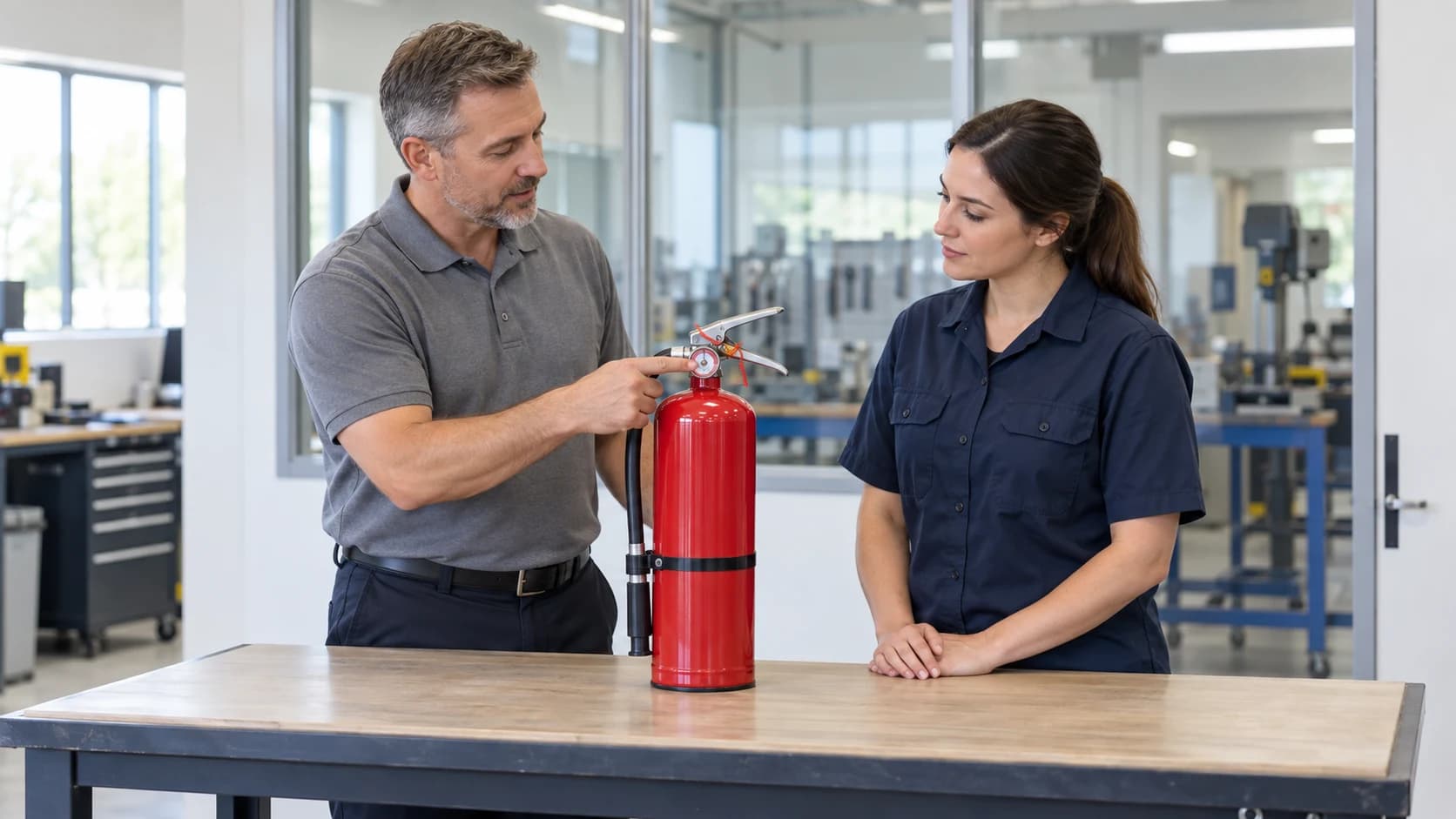
Make the evacuation decision first
An extinguisher is a limited tool. Smoke, rapid fire growth or an uncertain escape route can make an attempt unsafe. This course puts the decision to withdraw alongside equipment selection and the basic principles of extinguisher use.
- Distinguish fire classes and match an extinguisher to the hazard
- Recognize when smoke, fire growth or the escape route makes evacuation the right response
- Understand pull, aim, squeeze and sweep within the limits of the equipment
- Report readiness problems and connect the lesson to your employer’s emergency action plan
Finish the instruction at your workplace
Confirm your employer’s evacuation or designated-user policy, alarm and reporting methods, escape routes, assembly point and the equipment actually provided. Designated users need training with appropriate equipment. Use the included employer worksheet to record that follow-up. Watching a video does not demonstrate practical operating ability.
Eight modules, from fire recognition to workplace response
Two questions follow each module. A ten-question randomized final assessment follows the teaching modules. Evergreen’s passing score is 80%, with unlimited retakes.
- 01
Fire fundamentals
How fires start, sustain themselves and develop beyond a small-fire response.
- 02
Fire classifications
Ordinary combustibles, flammable liquids, energized equipment, combustible metals and cooking oils.
- 03
Types of extinguishers
Water, carbon dioxide, dry chemical, wet chemical, specialized agents and equipment labels.
- 04
Deciding whether to fight a fire
Authority, early-stage limits, alarm reporting, smoke, fire growth and a reliable escape route.
- 05
Using an extinguisher
Protecting your exit, approach distance and the pull, aim, squeeze and sweep sequence.
- 06
Common mistakes and hazards
Wrong equipment, electrical and liquid-fire hazards, reignition, empty units and withdrawal.
- 07
Inspection and readiness
Access, damage, gauge, pin and seal checks; reporting problems and the employer’s maintenance program.
- 08
Emergency action plan
Your employer’s policy, assigned duties, alarms, routes, assembly and equipment-specific follow-up.
Who should take it
- General-industry employees whose employer provides extinguishers for employee use
- Designated extinguisher users completing the general education portion of their training
- Workplace teams reviewing initial or annual fire-response instruction
This is employee education. It does not qualify a firefighter, fire-brigade member, rescuer or extinguisher service technician. Employees assigned evacuation-only duties must follow that policy. Construction and other separately regulated settings need instruction suited to their rules.
Regulatory basis and recurring instruction
- 29 CFR 1910.157(g)(1)–(2)
General use principles and small-fire hazards education where extinguishers are provided for employee use, initially and at least annually.
- 29 CFR 1910.157(g)(3)–(4)
Appropriate-equipment training for employees designated under an emergency action plan, on assignment and at least annually.
- 29 CFR 1910.157(b) and 1910.38
Fire-response policy, exemptions and emergency action plan responsibilities inform workplace-specific instruction.
Federal general-industry scope. State-plan requirements may add obligations. The certificate records online course completion; it is not OSHA approval or a guarantee of workplace compliance.
Connect the course to your emergency procedures
Keep employee education, workplace instruction and records together.
Purchase seats
Buy online or request a team invoice.
Assign learners
Distribute purchased seats through your account.
Complete workplace instruction
Review your policy, alarms, exits and supplied extinguishers; complete designated-user equipment training where applicable.
Keep records and plan the next training
Download the certificate and crosswalk. Use the annual planning reminder alongside your employer’s actual training schedule.
Review the course resources
The crosswalk maps this course to federal requirements. The forms support employer follow-up; they do not certify completion of unperformed instruction.
Fire extinguisher training questions
Who needs fire extinguisher education?
Under federal OSHA’s general-industry rule, where an employer provides portable extinguishers for employee use, the employer must provide education on general use principles and the hazards of incipient-stage firefighting. Applicability depends on the employer’s fire-response policy and the standard’s exemptions.
Is annual instruction required?
The education required by 29 CFR 1910.157(g)(1) is provided on initial employment and at least annually thereafter. Employees designated to use firefighting equipment under the emergency action plan receive appropriate-equipment training on initial assignment and at least annually thereafter under paragraphs (g)(3) and (g)(4).
Does this course authorize me to fight a fire?
No. Your employer decides whether you must evacuate or are designated to use equipment. The course emphasizes alarm reporting, a clear exit and prompt withdrawal. It does not authorize firefighting, rescue or entry into a dangerous atmosphere.
Does online training replace equipment practice?
No. The course supplies general principles. The employer must complete instruction suited to the actual equipment and workplace, including the training required for designated users. The employer worksheet helps document this follow-up; watching video does not verify practical operating ability.
How long does the course take?
There are approximately 28 minutes of video across 55 short lessons, eight module quizzes and a ten-question randomized final assessment. Allow extra time for the assessments and workplace instruction. This duration is not an OSHA-prescribed minimum.
What score do I need, and are retakes allowed?
Evergreen Comply requires 80% on assessments and permits unlimited retakes. The passing score is our course standard, not an OSHA-mandated score.
What does the certificate show?
After online course completion and passing the assessments, learners can download an Evergreen Comply certificate with a one-page regulatory crosswalk appended. It records course completion, not OSHA approval, firefighter qualification or completion of unperformed workplace instruction.
What is the price and language?
The one-time base price is $29 USD per seat before applicable tax. Instruction is in English. Employers must ensure workers understand their training. Teams can purchase seats online or request an invoice.

Know your equipment. Protect your way out.
Practical employee instruction with workplace follow-up built in.