
Reasonable Suspicion:Workforce Awareness
Drug-and-alcohol awareness training for the general workforce under 49 CFR Part 382: recognize, document, and escalate impairment concerns.
100% onlineEnglishInstant signed certificate
Course Overview
Give your frontline leaders a repeatable process that protects people, equipment, and contracts before an incident happens.
Actionable indicators
Behavioral and physical signs to watch for, plus how to separate rumor from observation.
Team-ready platform
Assign seats, track completion, store observation forms, and resend certificates instantly.
English course
Lessons, narration and the certificate are in English. Employers make sure each learner understands the training.
49 CFR Part 382
FMCSA drug & alcohol program framework
FMCSA's controlled-substances and alcohol testing program is set out in 49 CFR Part 382.
This awareness course introduces that framework at an awareness level. The prescriptive supervisor mandate is the separate 60/60 requirement at 49 CFR 382.603, which this course does not by itself satisfy.
Regulatory Basis
Every module maps to the exact regulation this course trains for. Each citation links to the official regulatory text.
- 49 CFR Part 382FMCSA's controlled-substances and alcohol testing program for CDL drivers, the framework this awareness-level course introduces.
- 49 CFR 382.603The separate, prescriptive supervisor-training mandate (60 minutes alcohol + 60 minutes controlled substances) that this awareness course does not by itself satisfy.
Who This Course Is For
Built for the people who make daily calls about fitness for duty, including:
Learning Objectives
Recognize indicators: Identify specific, contemporaneous signs of alcohol or drug misuse (appearance, behavior, speech, odors) tied to Part 382 guidance.
Document correctly: Record objective observations that stand up to internal reviews, auditors, and HR investigations.
Escalate smoothly: Engage the DER/HR, remove from duty when appropriate, and trigger testing timelines without drama.
Course Preview
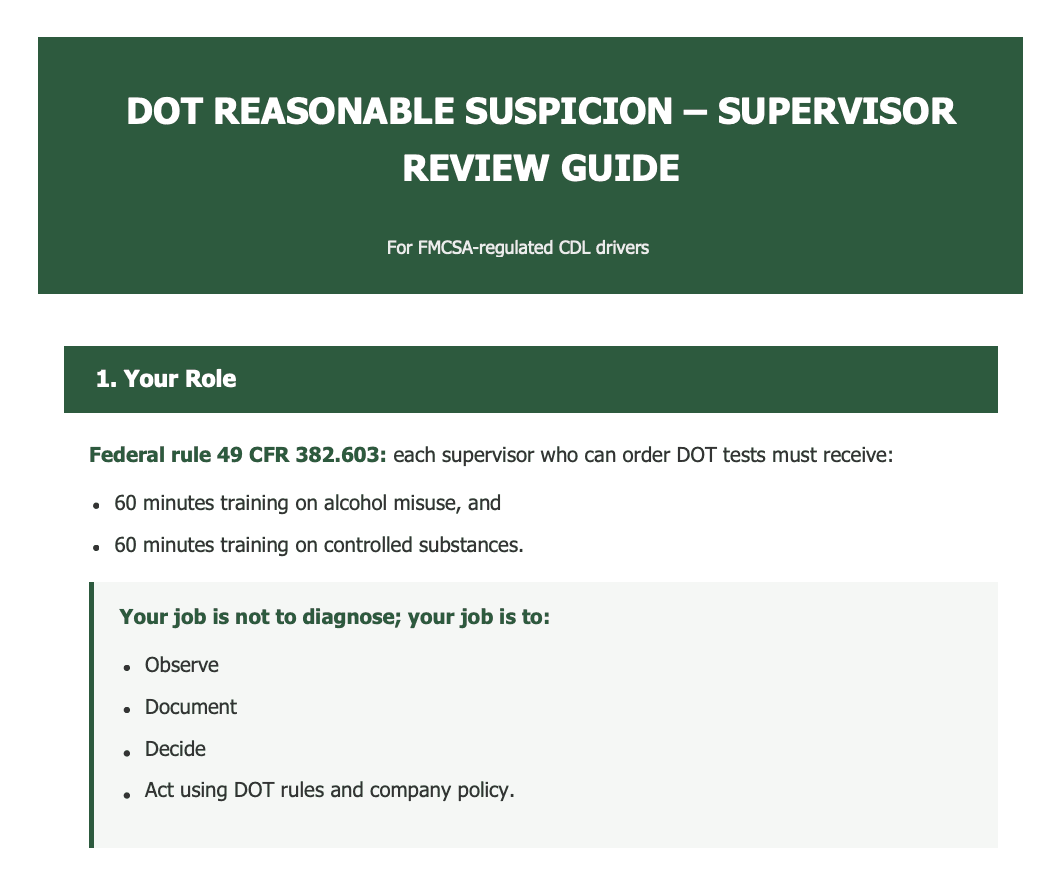
Reasonable Suspicion Review Guide
Quick, practical recap of the core Reasonable Suspicion concepts. Use it as an at-a-glance reference for indicators, documentation steps, and when to loop in your DER/HR.
What’s Covered
Course modules across practical, role-specific compliance workflows.
Part 1 — Foundation
- 01
What a Strong Reasonable Suspicion Program Requires
- 02
Alcohol vs. Controlled Substances: Effects and Field Indicators
- 03
Observable Indicators: Appearance, Behavior, Speech, Odors
- 04
Making the Call: “Specific, Contemporaneous, Articulable”
- 05
Documentation That Stands Up in an Audit
Part 2 — Role-Specific Operations
- 06
Removing from Duty and Notifying the DER/HR
- 07
Ordering the Right Test and Meeting Timelines
- 08
Scripted Conversations That Reduce Tension
- 09
Confidentiality, Due Process, and Follow-up
- 10
Scenarios and Role-Plays: Practice the Decision
Get Your Team Started
Four steps to compliance. Most teams are up and running in under 10 minutes.
Purchase seats
Choose the number of seats your team needs. Volume discounts available.
Assign to your team
Add employees from your dashboard — takes about 2 minutes.
Complete training
Self-paced modules with quizzes. Learners pause and resume on any device.
Download certificates
Automatic recordkeeping with audit-ready certificates and training logs.
“I've been in the industry for over 20 years. This is honestly the best training that I've seen.”
Texas-based C/TPA
Frequently Asked Questions
What is reasonable-suspicion awareness training, and who is it for?
It's a general-workforce introduction to recognizing signs of drug or alcohol misuse, oriented to the FMCSA framework in 49 CFR Part 382. It suits frontline leads and staff who need awareness but are not the designated CDL-driver supervisors covered by 49 CFR 382.603.
Is this the same as DOT supervisor reasonable-suspicion training?
No. The DOT supervisor requirement is 49 CFR 382.603, which mandates 60 minutes alcohol + 60 minutes controlled substances. This awareness course is shorter (about 60–75 minutes) and does not by itself satisfy 382.603; supervisors of CDL drivers should take the full supervisor course.
Under which regulation does this fall?
It aligns to FMCSA's drug-and-alcohol program at 49 CFR Part 382 at an awareness level; the prescriptive supervisor mandate is the separate 382.603.
How often should it be renewed?
Part 382 sets no fixed interval for awareness training; employers typically refresh periodically as a policy matter. It carries no federal recurrence requirement.
Is it online, and how long does it take?
Yes — fully online, self-paced, in English, about 60–75 minutes, with an instant completion certificate.
Who should take the full supervisor course instead?
Anyone designated to supervise CDL drivers should take the §382.603 supervisor course, which this awareness course does not replace.
Which course do I need?
Three related DOT drug-and-alcohol courses. Compare who each one is for before you enroll.
- Best for
- For supervisors who decide when a CDL driver must be tested
- Renewal
- Once; no federal recurrence
- Duration
- 2 hrs (60 + 60)
- Best for
- For frontline leads and staff who need awareness, not authority
- Renewal
- None federally required
- Duration
- 60–75 min
- Best for
- For the named DER and HR or compliance staff who support them
- Renewal
- None federally fixed
- Duration
- 2–3 hrs
Availability and pricing are shown on each course page and confirmed at checkout. Renewal intervals reflect the cited federal regulations.

Stop issues before they become incidents
Equip the people who make day-to-day calls with observation checklists, conversation scripts, and escalation steps that match DOT expectations.